Give the model the right context.
Distinguish state, memory, and context. Design retrieval that supplies attributable evidence rather than a larger prompt.
A BOOK FOR SOFTWARE ENGINEERS
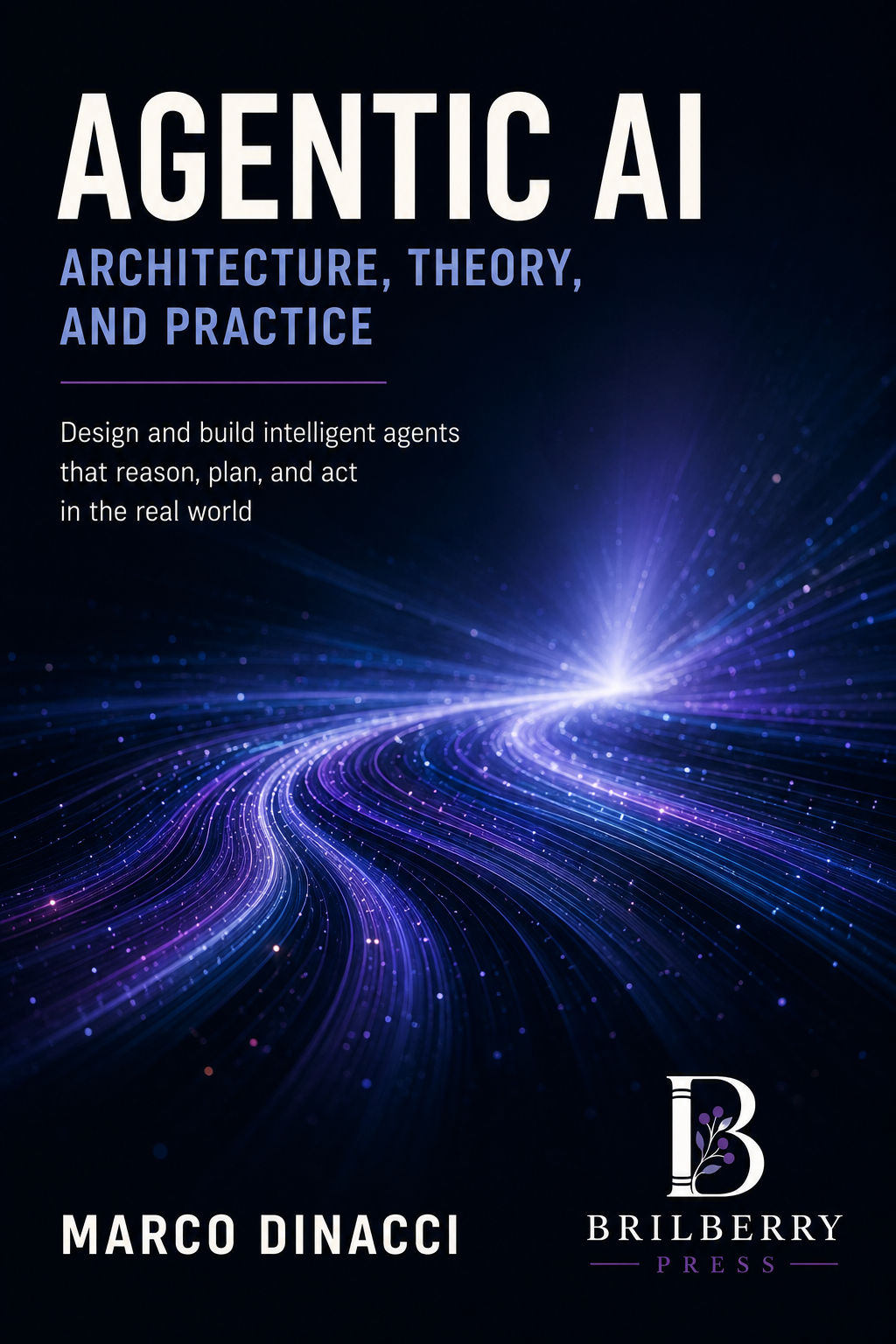
AGENTIC AI
Architecture, Theory, and Practice
Build systems that reason, plan, and act.
Understand the architecture that makes them reliable.
01 / THE FIRST EDITIONFROM INFERENCE TO ACTION
01 / THE APPROACH
A capable model is the starting point. Building an agent that operates reliably takes software engineering.
This book examines what surrounds the model: the tools it can use, the context it receives, the state it preserves, and the rules that govern its actions. It connects these choices to familiar ideas from distributed systems and software architecture.
For software engineers, architects, researchers, and graduate students who want to understand the design decisions behind agent systems.
Concrete mechanisms. Explicit trade-offs.
Examples you can reason about.
02 / WHAT YOU’LL LEARN
Distinguish state, memory, and context. Design retrieval that supplies attributable evidence rather than a larger prompt.
Design tool contracts, explicit plans, and agent harnesses. Preserve progress across sessions and verify when work is complete.
Trace observable execution, evaluate outcomes, and compare quality, latency, and cost across complete systems.
Choose when to delegate, establish ownership and approvals, and enforce boundaries around tools, memory, and execution.
03 / INSIDE THE BOOK
Start with the agent loop. Follow it through context, tools, and coordination into the realities of production.
Four parts · Fourteen chapters
04 / THEORY, PUT TO WORK
Concise Python examples sit alongside the explanation. Follow an OAuth migration, a repository investigation, a dependency audit, and a governed delivery workflow.
The accompanying bbagents library turns the book’s concepts into typed, executable components for plans, policies, context, memory, and observability.
THE MODEL PROPOSES. THE RUNTIME ENFORCES.
BUILD WITH A CLEARER MENTAL MODEL
Agentic AI
Architecture, Theory, and Practice
Fourteen chapters on the engineering
behind systems that reason and act.
$9.99 USD
Checkout opening soonPurchases will be processed through Stripe.
A FEW DETAILS
Experienced software engineers, architects, researchers, and graduate students. Familiarity with Python and software architecture will help you get the most from the examples.
The book focuses on architectural mechanisms and trade-offs. It uses concrete tools and protocols, including LangGraph, MCP, and A2A, while keeping the core ideas independent of any one vendor.
Yes. Chapter 8 covers harness composition, reusable skills, work across sessions, and production execution. Context management, evaluation, and security are developed in their respective chapters.
Checkout is not open yet. When available, the purchase button will take you to Stripe, where the price, format, and delivery details will be confirmed before payment.